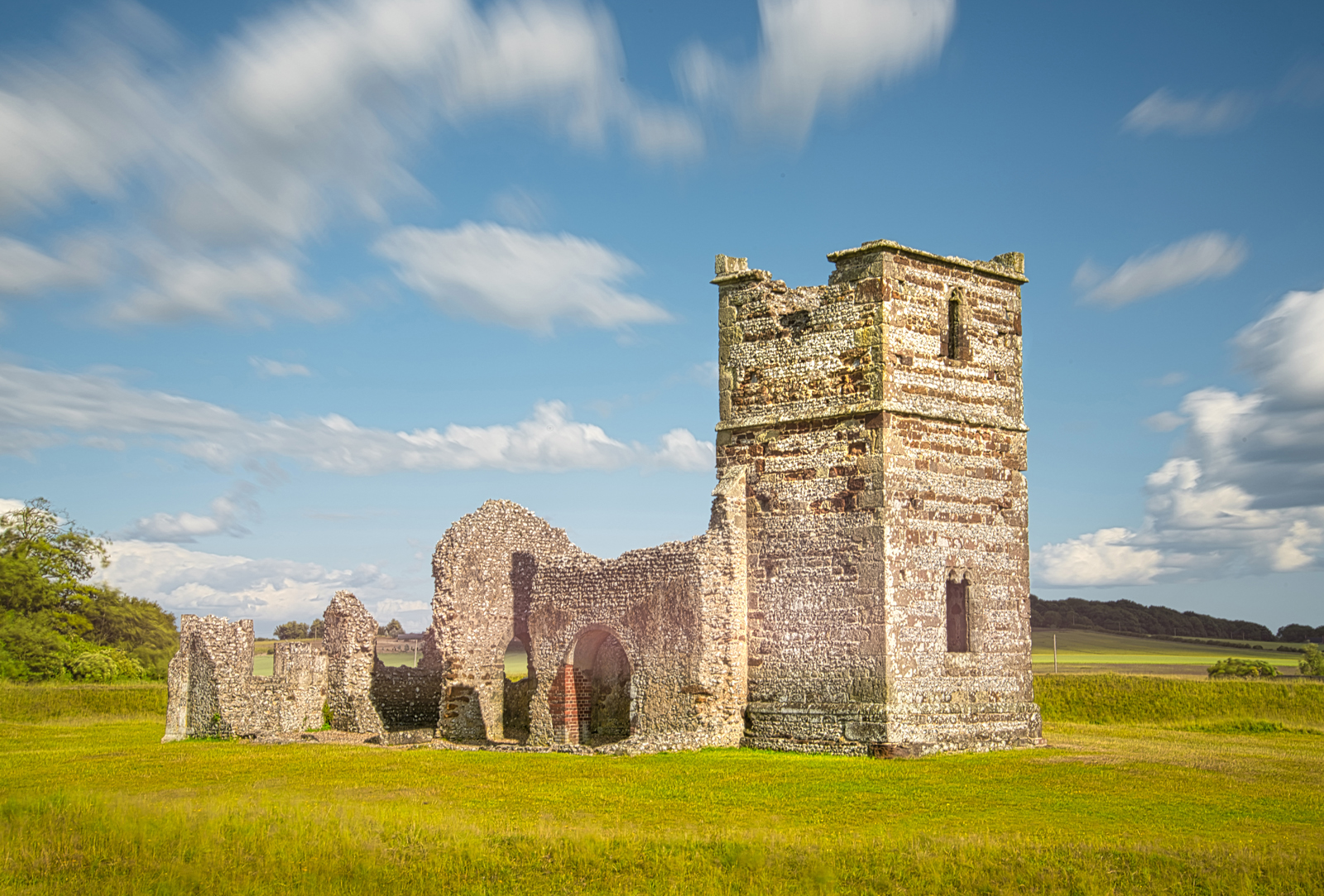
Knowlton Church, Dorset, with part of the Great Barrow left background. Photograph by Alan Bentley (Nikon D810, 50 mm, f/18, 30 secs., ISO 64, ND1000 filter).
A unique group of Neolithic monuments in Dorset which have remained a significant and atmospheric presence for over 4,000 years and which became a place for Christian worship.
Knowlton is a hamlet that lies on the B3078 between Cranborne and Wimborne Minster. The church (probably one of the most photographed historic buildings in east Dorset) of unknown dedication, is located within a larger, ancient monument. The English Heritage sign at the entrance to this site says “A Norman church extensively re-modelled in the 14th century. It stands inside a late Neolithic Henge monument constructed c2500 BC. This consists of a ring bank [just visible in the photograph] with two entrances and an internal ditch: it was probably meant for ceremonial use”.
This site is part of a larger complex consisting of five large circular or sub-circular monuments. Three of the five monuments are henges, with banks outside their ditches: the Southern Circle (the largest), the central or Church Henge, and the Northern Circle, marked by a group of ancient yews. Next to these lies a smaller monument with an external ditch, known as the Old Churchyard, and also likely to be prehistoric (despite the name). On the other side of the central henge is a large tree-covered mound called the Great Barrow, the largest barrow in Dorset, and is surrounded by two concentric ditches.
Interesting as the complex is in itself – and the visible earthworks may only be the tip of an iceberg; aerial photography has revealed many other barrows and ditches in the vicinity – the later reuse of the site, and the legends it has spawned, are equally fascinating. In Anglo-Saxon times, people were buried close to the Great Barrow. Then in the 12th century, uniquely among henge monuments, a church was built within Church Henge (hence its name), serving a now vanished community. This subsequent use explains the good state of preservation of this henge compared with that of the other two.
The church was abandoned in the 18th century, about the same time that the antiquary William Stukeley (1687–1765) recounted a local tale that Knowlton had once been “an old city; and that strangers had come out of their way on purpose to see it; that ruins and foundations were there; that it had seven parish-churches, which were beaten down in the war time”. In fact there has only ever been one church at Knowlton. Perhaps the legend of seven churches is based on a false assumption that each of the Neolithic enclosures once had its own.
The site’s religious traditions continue to the present day with a local Druids’ grove regularly using it to celebrate the turning of the wheel of the year.
According to Christopher Dalton’s ‘The Bells and Belfries of Dorset’ at the 1552 inventory Knowlton church had three bells and a ‘lyche’ bell. The three bells remained until 1740 after which the chapel furniture was removed, the roof fell in and the bells disappeared.
There is a tradition that one of the bells was taken and carried off to Sturminster Marshall (some 12 miles by road from Knowlton). According to legend, this was theft and tales have sprung up around the bell’s removal from the old church. One local rhyme declared: “Knowlton bell is stole and fallen into White Mill hole”. The hole is a deep place in the bed of the River Stour, by White Mill Bridge at the approach to Sturminster Marshall. By the mid 19th century, the story was that the robbers were overtaken by angry Knowlton men at the bridge, and they threw the bell into the river rather than give it back. Three times the Knowlton men tried to drag it up but the rope broke each time. John Camp in his ‘In Praise of Bells’ has a variation of the rhyme: “All the Devils in Hell, Could never pull up Knowlton’s Bell!”
Dalton surmises from various accounts that the ‘stolen’ bell may have either been: left in the river; obtained, perhaps legitimately, and taken to Shapwick church (nearly 2 miles from White Mill) to become the now former clock bell; recovered by the parishioners of Horton, which would have included the residents of Knowlton. The mystery remains.
Much of the information about the monuments was obtained from the English Heritage web site which also has a very good aerial photograph of the complex showing the outline of the earthworks. The monuments are also visible on Google earth.
Compiled by Alan Bentley






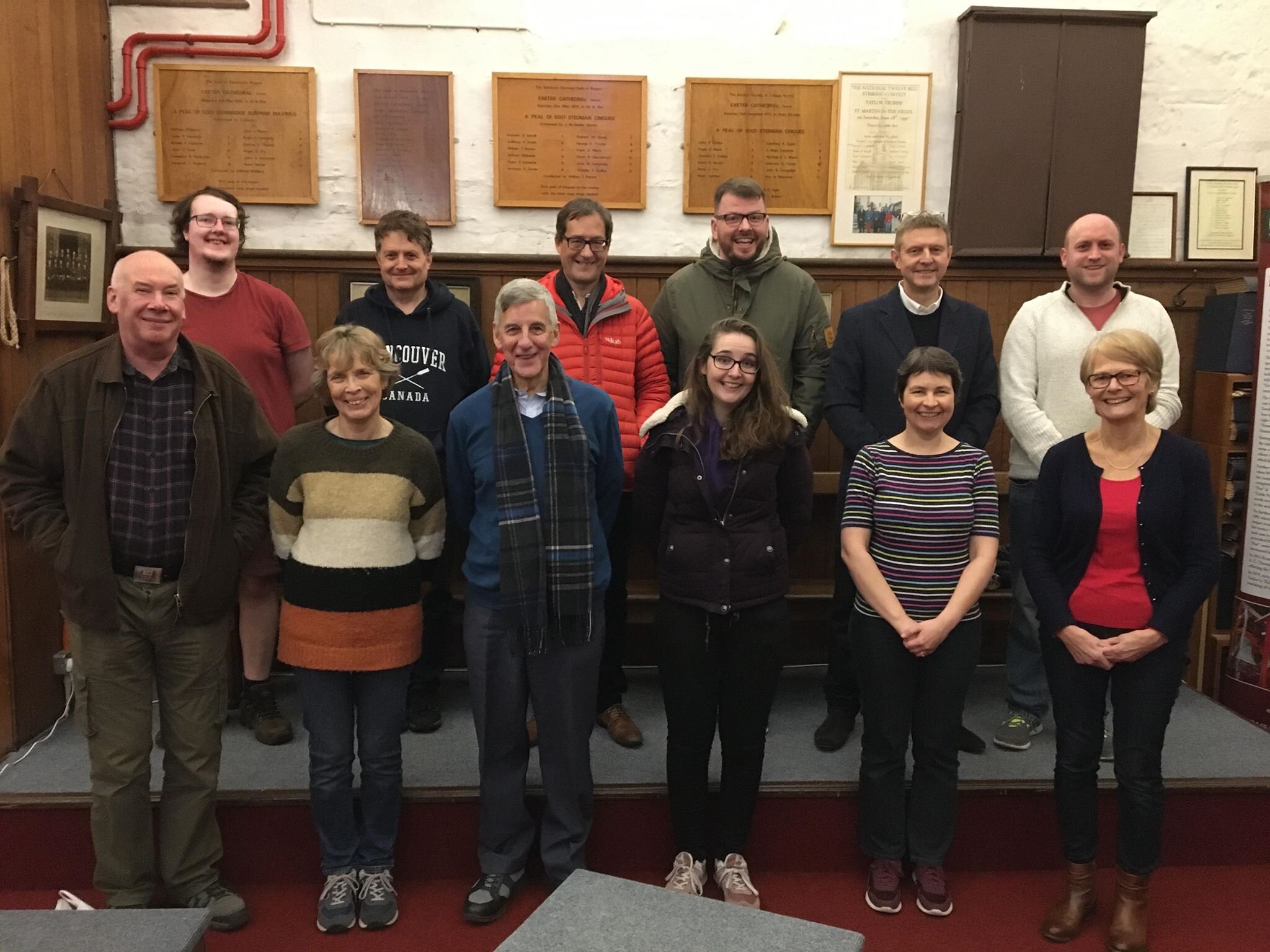
 Wimborne Minster Bell Ringers