The Society was formed in 1883, under the presidency of the Vicar, the Rev F J Huyshe. It comprised 7 ringers together with the Tower Captain and with the provision for up to 14 probationary ringers. Unfortunately the list of founder members has been lost but the Tower Captain was Mr Thomas Hart with the secretary & treasurer Mr George Yeatman. Two committee members were Mr George Lock and Mr A H Wareham.
Indeed reference was made in a local paper (Poole) of the intent in 1883 to form a society which would subsequently be affiliated to the recently formed “Diocesan Guild of Ringers” (sic) with the object of improving the character of the ringing in the churches in the diocese. This article also mentions two previous societies but with no other details. This date may have been determined since in 1882 reinforcements to the parapets meant that no ringing was advised for a year. In 1884 there was a report in the Parish Magazine of good ringing at a meeting of the Diocesan Guild. However ringing ceased for a while as it was also reported in 1885 that one bell had fallen and the bells were rehung.
There is clear evidence of ringing at the Minster before this date, a letter to Churchwardens dated 1873 confirming that the bells should be rung for appropriate services. Indeed in the Churchwarden Accounts of 1760 there is payment to the ringers for the bells being rung for services. There is also a letter dated c1822 from several townspeople requesting a meeting with the Churchwardens to discuss the formation of a group of ringers for the Minster bells.
Reference in 1844, from the Liverpool Mail to bell ringers at Wimborne Minster and in 1845 a note made about musical heavy ring of 6 bells.
Charles Gomer, a ringer for 40 years died in 1868, aged 65. In his obituary there is reference to a muffled peal rung at his funeral.
From an article in the Parish Magazine of January 1888; there was a first “peal of half-pull changes of 120” The ringers were listed as T Hart, A Wareham, E Meader, W Meader, G Lock, T R Poole, E Tubbs and G Hart.
In the original rules of the Society, a copy of which hangs in the ringing chamber, there is a clear distinction between the “ringers” and “probationers”. The ringers were expected to ring for all Sunday services and were paid. The Churchwardens paid an annual amount of £15 increasing to £20 to the ringers for this. In addition the Tower Captain was also paid £1 in order to ensure that the bells were oiled and the belfry kept clean.
Although there is little record of the standard of ringing achieved during these early years, the society was active and there is much mention in both the AGM minutes and articles in the parish magazine about outings attended by the members often covering reasonable distances, eg London in 1885 and Portsmouth in 1890.
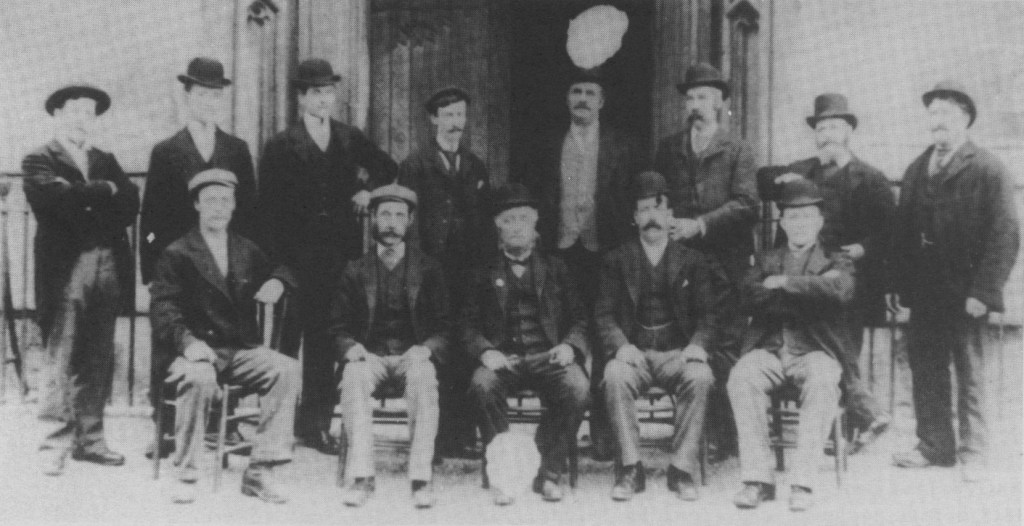
Ringers in 1900: L to R standing: W Meader, F Hart, Osman Jr, T.F. Coles, A. Osman, G. Lock, G. Miller, G. Hart: seated F. Gibbs, E. Meader, T. Hart(capt), W. Slade, E. Tubbs
The first peal on the bells, was scored in 1902 although there was a peal attempt in 1886 by members of the Diocesan Guild and the “Ancient College Youths” (sic) which unfortunately came to grief after 4000 changes. Indeed the bells became difficult to ring which resulted in the eight bells being recast and their augmentation to 10 in 1911. The rules were changed in 1912 to allow for 9 “ringers” although the Churchwardens stated that they could not increase their payment to the ringers.
The first peal on the new 10 bells was in 1911 and involved one member of the society, Alfred Osman who rang the tenor. He had joined the Society in 1901.
His obituary gives him as a “22-stone tenor ringer”
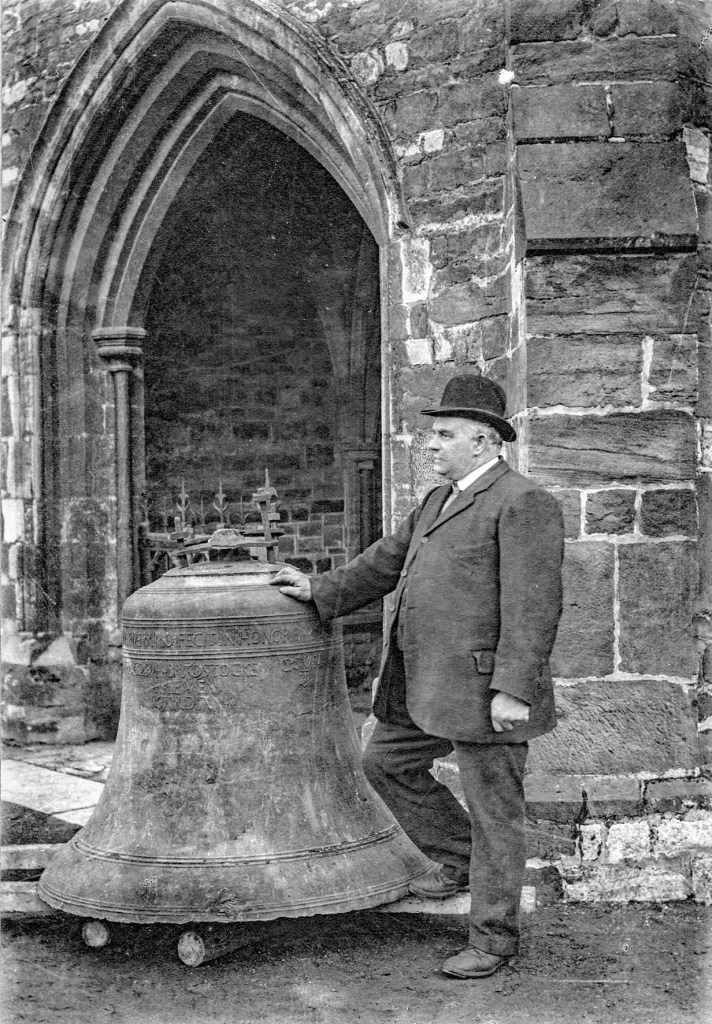
Alfred Osman and the old Tenor bell
The minutes of the AGMs held each year, as required by the rules, feature their annual outing but also involve much detail of the payment to ringers for service ringing. There was continued distinction between ringers and probationers with some being made up as “ringers” as vacancies arose due to illness or moving away. During WW1 the ringers were allowed to ring for Sunday services but no practices. There is also mention of Honorary Members. Indeed in 1915 there is reference to the first lady ringer of the society a Miss Hanham. It is also clear that a collection of money at Christmas was a regular thing. This tradition seems to have still been occurring in the 1920s.
In 1919 it was proposed that a board should be purchased and hung in the belfry to contain the names of past and present members. This tablet, “Roll of Honour” was hung in 1920 and remains to this day.
With thanks to Gill Richards, and Kathy and Alan Bentley for researching and writing this history of the Society.
 Wimborne Minster Bell Ringers